Scalping checklist before every entry: use Ladder Scalper to filter setups
Most scalpers fire on a single timeframe chart and hope the bigger picture is friendly. When it isn't, the trade reverses into the nearest higher-timeframe trend. A scalping checklist before every entry means asking five questions and letting your tool filter out the ones that fail. Ladder Scalper automates that checklist by running your setup through four timeframes at once.
Your scalping checklist before every entry: five questions
Before you hit Buy or Sell on any scalp, check these five things. Ladder Scalper answers all of them without you having to switch charts.
Question 1: Is the timeframe ladder aligned?
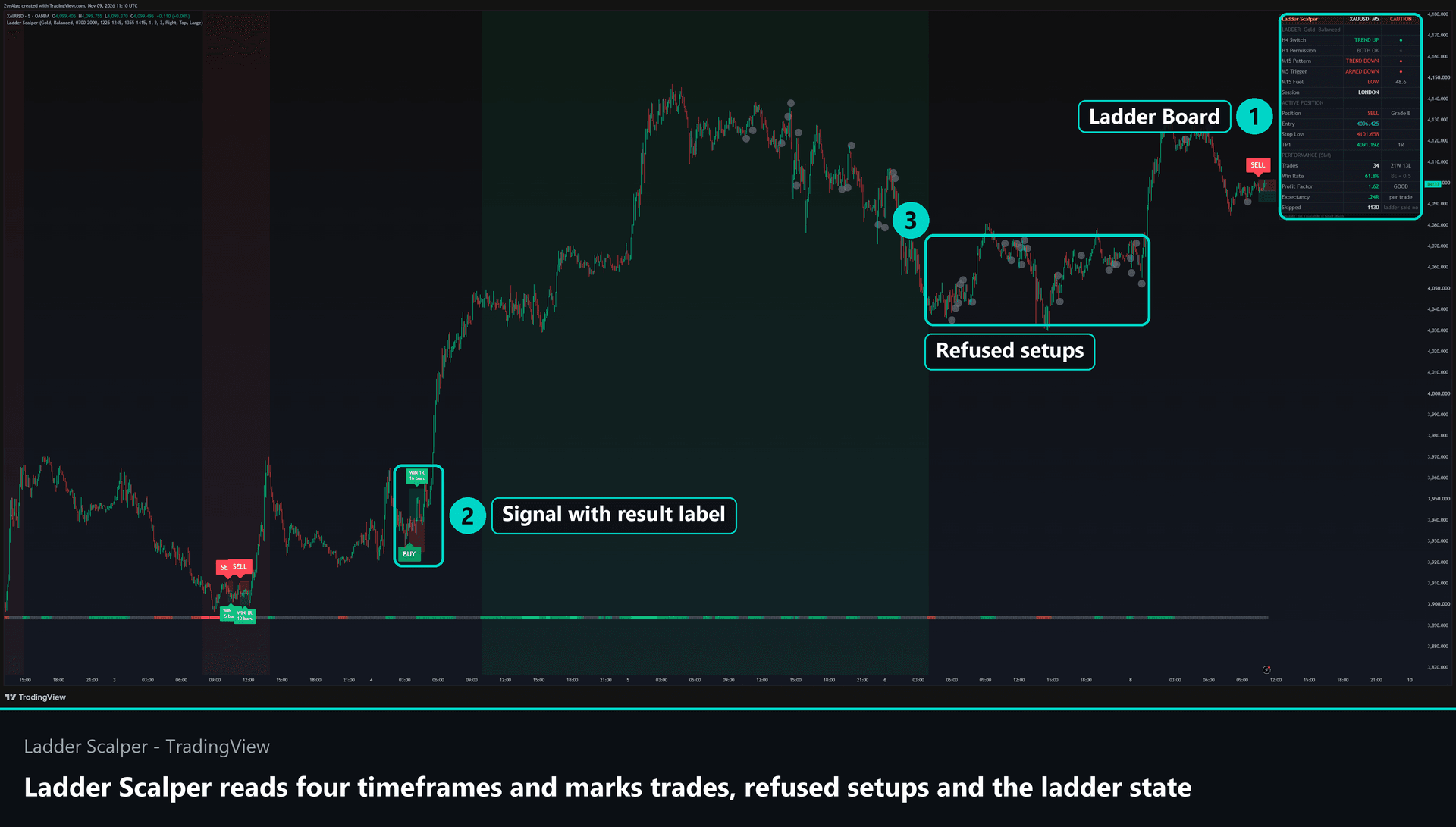
Ladder Scalper reads four timeframes automatically built from your chart. On Gold M5, that is M5 for the trigger, M15 for the pattern, H1 for permission, and H4 for the switch.
The Switch and Permission timeframes set the market mode. If both agree on direction, the market is in Expectation mode and trades are grade A, using all three targets. If they disagree or are flat, you are in Caution mode and trades are grade B, capped at TP2. When you see a signal, hover it to read which leg said yes and which said no. A grey dot marks a setup the ladder rejected and tells you exactly why.
This is your first check: does the bigger picture agree with the trade you are about to take?
Question 2: What is the session and nearby structure?
Ladder Scalper watches your session window (you can set it in UTC, or leave it off). The Ladder Board shows your current session so you know if you are trading the busiest liquidity or the quiet hours.
Structure for your stop comes from the last 8 chart candles. For Gold, the stop sits beyond that structure plus 0.25 times ATR. For Bitcoin, it is 0.30 times ATR. The tool draws your stop on the chart; you read how many pips or points that is and ask: am I comfortable with that risk on this trade? A setup is skipped if the stop would be wider than the profile allows, keeping you from oversizing.
Question 3: Is there 1.5R of room to resistance?
After entry, the first target (TP1) is 1R. The second (TP2) is 2R. The third (TP3) is 3R. But if there is not at least 1.5R of clear space between entry and the nearest Pattern or Permission resistance level, the setup is rejected. The tool shows you this filter in action with a grey dot and the reason on hover.
This prevents you from entering a scalp that gets crushed by imminent resistance. You have room to breathe.
Question 4: What are your targets in R?
Ladder Scalper defaults to TP1 only (1R), the safest choice for scalping. You can enable TP2 (2R) and TP3 (3R) in the settings. When TP2 is on, breakeven stop management is available: once TP1 is hit, the stop moves to entry, so your remaining position is free. At TP2, the stop moves to TP1.
This is your profit ladder. Build it deliberately, not by guessing at the chart.
Question 5: Are you chasing or is RSI turning?
The Trigger timeframe (your chart) needs a pullback: RSI must have reached 45 or lower in the last 10 candles. Then it must cross back above its fast average and sit at or above 50, all within the last 2 candles. Finally, the candle closes above the previous high.
If chart RSI is already at 75 or higher, the signal is skipped (no chase). This prevents you from chasing into overbought scalps.
A real session: checking your scalping checklist
You load Gold M5 at 09:30 UTC (London open, high liquidity). The Ladder Board shows Expectation mode: H4 and H1 both agree the market is bid. That is your first green light.
A BUY signal prints at 09:35. You hover it and read: Permission OK, Pattern OK, Pullback and Turn confirmed, Break confirmed. The stop is 8 pips below entry (Gold ATR is around 2.5, so your stop is 0.25 x 2.5 plus the last 8-candle low). You have 24 pips to TP1 and 48 to TP2, both clear of the next round number at 2110. Room is 2.0R, above the 1.5R minimum.
You hit Buy. TP1 at 1R fills, breakeven stop moves to entry. You hold TP2 on the remaining position. At the next 1R (TP2), the stop moves to TP1 (breakeven on the full original position). You are protecting profit while scalping.
That checklist took 10 seconds because Ladder Scalper did the math. Without it, you would be switching between three timeframes, checking RSI, measuring room to resistance, and calculating R by hand. You would miss half the trades and second-guess the other half.
Ladder Scalper TDV
Takes a scalp only when momentum lines up along a four-timeframe RSI ladder, and shows every setup it refused and why. Closed-candle signals, no repaint.

What it does not do
Ladder Scalper does not eliminate market risk. No indicator removes the chance that price moves against you fast. It does not predict reversals or guarantee entries. The Performance section in the Ladder Board is an internal simulation over past chart data, before spread and commission. It is not a broker report and not indicative of future results.
On small timeframes like M1 and M5, spread and commission weigh more on each trade than on swing setups. The simulation does not include them. You must test your signal quality including your broker costs and slippage in your own backtest or paper trading.
Ladder Scalper is a tool for analysis and education. It is not financial advice. Always apply your own analysis and position sizing.
Start with the checklist
Load Gold M5 with Ladder Scalper and set your chart to Balanced Signal Mode (default). Read the first five signals and hover each one to see which leg said yes and which said no. Watch a few grey dots and read why they were skipped. This is your checklist in action: the tool is showing you every trade it would take and every one it refuses and why.
Once you see the pattern, you have your scalping checklist locked in. Enter your session window and trading hours in the settings and you are ready to paper trade and test whether the filtered signals work for your broker, your spread, your style.
Ladder Scalper TDV
Takes a scalp only when momentum lines up along a four-timeframe RSI ladder, and shows every setup it refused and why. Closed-candle signals, no repaint.