TradingView Indicator Industry News: November 2026
Summary: The autumn of 2026 brought three big shifts for anyone who uses TradingView indicators. TradingView rewrote its rules for selling invite-only scripts and expanded its Marketplace, AI coding tools arrived both inside TradingView and from indicator vendors, and LuxAlgo launched its own charting platform, Vela. This roundup covers what happened from August to mid-November 2026, with dates and links to the official announcements.
Every item below was checked on the official source (the company's own blog or TradingView's blog and Pine Script release notes) on 18 November 2026. Where a source gives only a month and day, the year was confirmed from the page itself.
TradingView: new rules for selling scripts
Commercial scripts and the Marketplace (30 September 2026)
What happened: TradingView announced updated Terms of Use for invite-only scripts. The original plan said that, from 1 November 2026, selling access to invite-only scripts outside the TradingView Marketplace would no longer be permitted.
Why it matters: most paid TradingView indicators are invite-only scripts, so the announcement raised questions for both vendors and buyers about where they could buy and renew.
The plan was revised (27 October and 6 November 2026)
What happened: on 27 October TradingView posted a Marketplace update saying more flexibility was coming, including the option to keep selling on a vendor's own website or as part of courses. On 6 November it published the new terms and confirmed that the 1 November restriction would not take effect.
Key points for traders from the new terms:
- Vendors can sell through the TradingView Marketplace, through their own channels, or both.
- For buyers, existing access is preserved, and Marketplace purchases are paid on TradingView with access granted automatically.
Why it matters: for traders, the practical message is continuity. You can still buy indicators from a vendor's own site or from the Marketplace, and access you already have stays in place.
The Marketplace keeps growing
What happened: TradingView first opened paid indicators and strategies to subscriptions inside the platform in November 2025, through "paid spaces" found in the Store tab of the Indicators menu. As of 18 November 2026, the Marketplace page lists paid spaces from a range of community authors, including Zeiierman, and well-known vendors such as ChartPrime and BigBeluga also have their own paid spaces.
Why it matters: buying inside TradingView means paying with the same methods you use for your TradingView plan, with access granted without extra links.
TradingView: AI arrives on the chart
AI Copilot launches (28 September 2026)
What happened: TradingView introduced AI Copilot, a paid add-on for every paid plan. It can read the chart, mark support and resistance, write Pine Script indicators and strategies and apply them to the chart, analyze backtest results, and create alerts and watchlists. It works on web and desktop, not yet on mobile.
Then (16 November 2026): TradingView added model choice, letting users pick between models from DeepSeek, OpenAI and Anthropic per chat, each with an adjustable reasoning level.
Why it matters: writing a simple custom indicator no longer requires knowing Pine Script. TradingView itself notes the assistant can make mistakes, so anything it writes still needs checking.
The TradingView MCP adds Pine Script tools (16 November 2026)
What happened: TradingView's MCP server, which connects outside AI assistants to TradingView, gained eight Pine Script tools: validating code, listing a script's inputs and plots, running an indicator or a backtest, searching scripts, reading your own and open-source code, and saving scripts to your account. Protected and invite-only scripts stay closed. Daily call limits by plan started on 17 November 2026.
Why it matters: an AI assistant can now check and test Pine code against TradingView's own compiler and data, which shortens the loop between an idea and a working script.
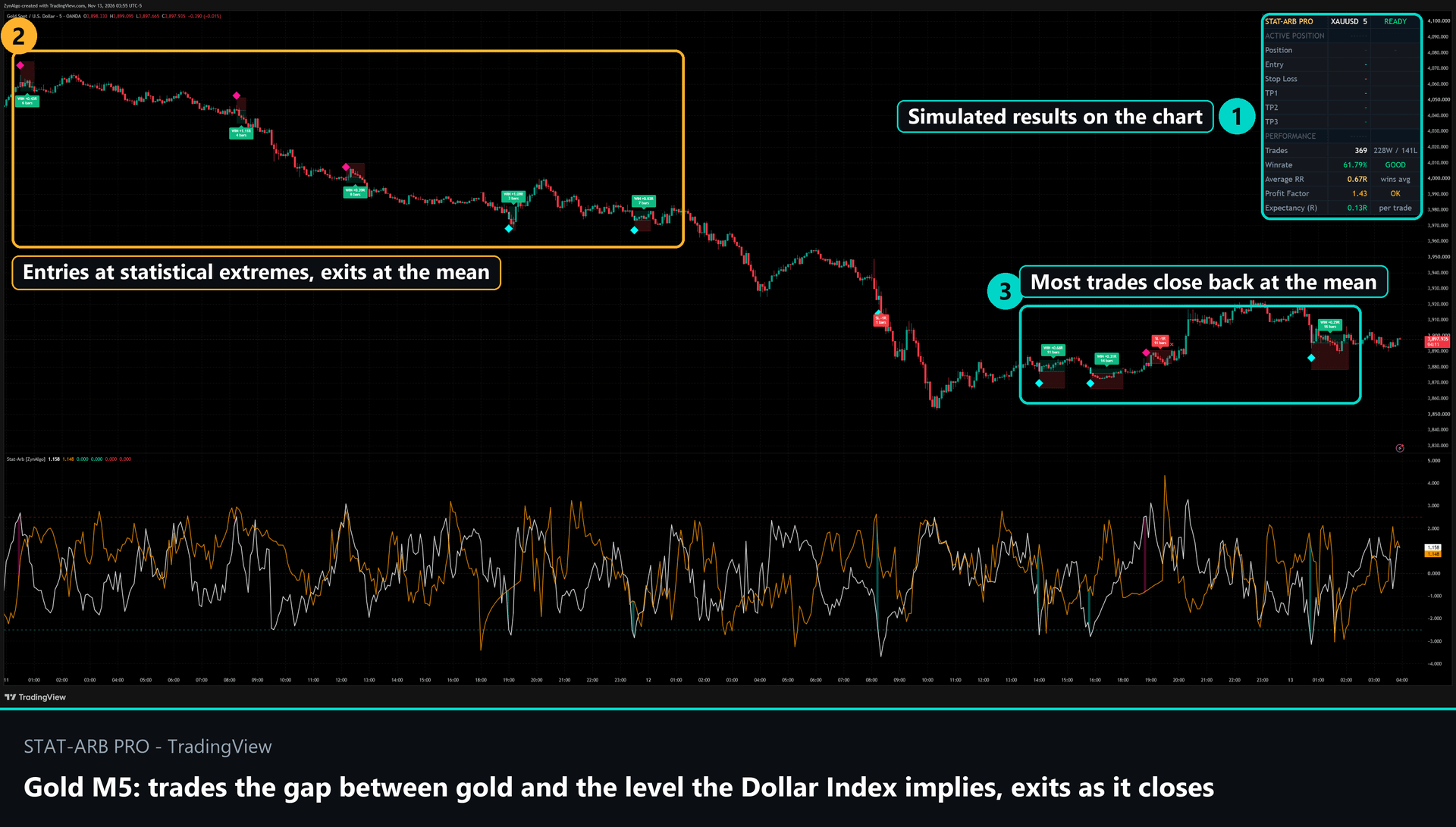
STAT-ARB Pro TDV
Trades gold's deviation from the level the Dollar Index implies and exits as the gap closes. Rolling regression spread, Auto preset for M5 and M15, closed-candle signals with a stop and a mean exit.

TradingView: platform and Pine Script updates
- Pine Screener, 40 requests (23 October 2026): the limit on request.*() calls per script in Pine Screener rose from 5 to 40, matching the chart. Multi-timeframe and benchmark-comparison indicators that were too heavy for the screener can now run unchanged.
- Custom second intervals (10 November 2026): Supercharts now support custom intervals from 1 to 299 seconds on the Ultimate plan, beyond the standard seconds-based intervals.
- Tick-based Footprint, Volume Delta and CVD (13 November 2026): a new optional mode classifies each trade as a buy or sell from market data instead of candle direction, using exchange aggressor data where available. It is available on the Ultimate plan.
- Pine Script release notes (September and October 2026): the official release notes list script tables that can move to a separate bottom-panel tab with copyable text (September), and more consistent alignment of inline inputs in the Settings tab (October). Earlier in the year, January 2026 added request.footprint() for reading volume footprint data in scripts.
Why it matters: order-flow and volume tools are getting more data to work with, and indicator settings and tables are becoming easier to read.
LuxAlgo: Vela and the Quant agent
Library expansion and MCP server (12 August 2026)
What happened: LuxAlgo expanded its Library to 861 technical analysis concepts across 17 families and launched an MCP server that lets AI assistants browse those concepts, explain them and pull Pine Script-compatible source code.
Vela launches (31 August 2026)
What happened: LuxAlgo introduced Vela, its own charting platform, live at vela.luxalgo.com and free to start. It ships with more than 800 indicators from the LuxAlgo Library, native order flow built from executed trades, footprint and TPO chart types, multi-chart layouts of up to 16 charts, and Quant, an AI coding agent that builds, debugs and backtests indicators and strategies.
Then: on 3 September LuxAlgo released Vela's core engine as open source under the Apache 2.0 license, with its Pine Script add-on licensed separately. On 28 October it launched alerts on Vela, delivered by email, Telegram, push, in-app notifications and, on paid plans, webhooks. On 3 November it released desktop apps for macOS, Windows and Linux.
Quant 2.0 and Backtest Loop (16 November 2026)
What happened: LuxAlgo announced Quant 2.0, starting with Backtest Loop. A trader describes a strategy and its targets, approves the plan, and the agent repeatedly writes, backtests and rewrites a Pine Script strategy, holding part of the data back for checking. It is available on LuxAlgo's Ultimate and Ultra plans.
Why it matters: Vela is one of the clearest examples of an indicator vendor building its own platform rather than relying only on TradingView, while still keeping Pine Script at the center of its tools.
Three trends to watch
- AI-assisted indicator coding is now mainstream. Within three months, TradingView shipped AI Copilot and Pine tools for its MCP server, and LuxAlgo shipped Quant and an AI-driven backtest loop. Writing and testing a custom script is becoming a conversation rather than a coding task.
- Vendors are building their own homes. Vela shows a vendor offering its own charts, data, alerts and desktop apps. At the same time, TradingView is making its Marketplace a stronger channel inside the platform. Traders now meet the same tools in more than one place.
- Alerts are moving closer to execution. Webhook alerts on Vela and alerts that AI assistants can create on both platforms point in the same direction: fewer manual steps between a signal and an action.
What this means for traders
- Your existing access is safe. TradingView's revised terms preserve existing access, and you can keep buying from vendor sites or the Marketplace.
- AI can draft, but you still verify. AI-written scripts and AI-tuned strategies are a starting point. Read the logic, test it on your own symbols, and treat results with caution.
- Check plan requirements. Several new TradingView features, such as tick-based order flow and custom second intervals, need a specific plan.
- Keep the chart readable. More tools and more AI output make it easy to overload a chart. Fewer tools with clear roles are usually easier to act on.
Where ZynAlgo fits
ZynAlgo continues to build focused TradingView indicators that each do one job and come with a full manual, from signal tools that draw entry, stop and targets such as Trendline v5.0 TDV to volume and footprint tools such as Footprint Pro TDV. For traders interested in the move from alerts to execution, ZynAlgo Automation sends indicator alerts to a connected broker account. You can try the style with the free indicators, or compare developers in our overview of top TradingView indicator developers in 2026.
FAQ
Can vendors still sell TradingView indicators on their own websites?
Yes. TradingView's 6 November 2026 terms allow selling through the Marketplace, through a vendor's own channels, or both. The earlier 1 November restriction did not take effect.
Can TradingView write indicators with AI?
Yes. AI Copilot, launched on 28 September 2026 as a paid add-on, can write Pine Script indicators and strategies and apply them to your chart.
What is LuxAlgo Vela?
Vela is LuxAlgo's own charting platform, launched on 31 August 2026. It includes the LuxAlgo Library, native order flow, alerts, desktop apps and the Quant AI coding agent.
Trading involves risk; indicators support decisions, they do not guarantee results.
STAT-ARB Pro TDV
Trades gold's deviation from the level the Dollar Index implies and exits as the gap closes. Rolling regression spread, Auto preset for M5 and M15, closed-candle signals with a stop and a mean exit.