How to Calculate Lot Size for Gold (XAUUSD): Formula, Pips and Prop Firm Rules
Quick answer: To calculate lot size on gold (XAUUSD), divide the money you are willing to lose by the stop-loss distance in dollars times the contract size. On a standard 100 oz contract: lot size = risk in $ ÷ (stop in $ × 100). A $10,000 account risking 1% ($100) with a $5 stop trades 0.20 lots. If you would rather not do the maths, use our free Gold Lot Size Calculator, which also has a prop firm mode.
Gold is one of the most traded markets for retail and prop firm traders, and also one of the easiest to size wrong. It moves several dollars in minutes, brokers count pips differently, and contract sizes are not always the same. This guide walks through the formula, the pip and point confusion, worked examples, and how to size gold trades on a prop firm challenge without breaking the daily loss limit.
Step 1: decide the money at risk
Lot size is the last thing you decide, not the first. Start with how much of the account one trade is allowed to lose. Most traders keep this between 0.5% and 2% of the balance.
- $5,000 account × 1% = $50 at risk
- $10,000 account × 1% = $100 at risk
- $100,000 prop account × 0.5% = $500 at risk
Fixing the money first means a wide stop simply gives you a smaller position, and a tight stop a bigger one. The loss if the stop is hit stays the same.
Step 2: measure the stop-loss in dollars
Gold is quoted in US dollars per troy ounce. The cleanest way to measure a stop is the price distance in dollars. If you buy at 2,650.00 and put the stop at 2,645.00, the stop is $5.00.
Many platforms and educators talk in pips or points instead, and this is where most sizing mistakes start.
Pips and points on XAUUSD
| Unit | Price change | Value per 1.00 lot (100 oz) | Value per 0.01 lot |
|---|---|---|---|
| 1 point | $0.01 | $1 | $0.01 |
| 1 pip | $0.10 | $10 | $0.10 |
| $1 move | $1.00 | $100 | $1 |
On most brokers one gold pip is $0.10, so a $5 stop is 50 pips, or 500 points. Some brokers and courses call $0.01 a pip. Always check how your platform counts it. Reading a $5 stop as 5 pips makes the position ten times too large, which is the single most common way traders blow a gold account on one trade.
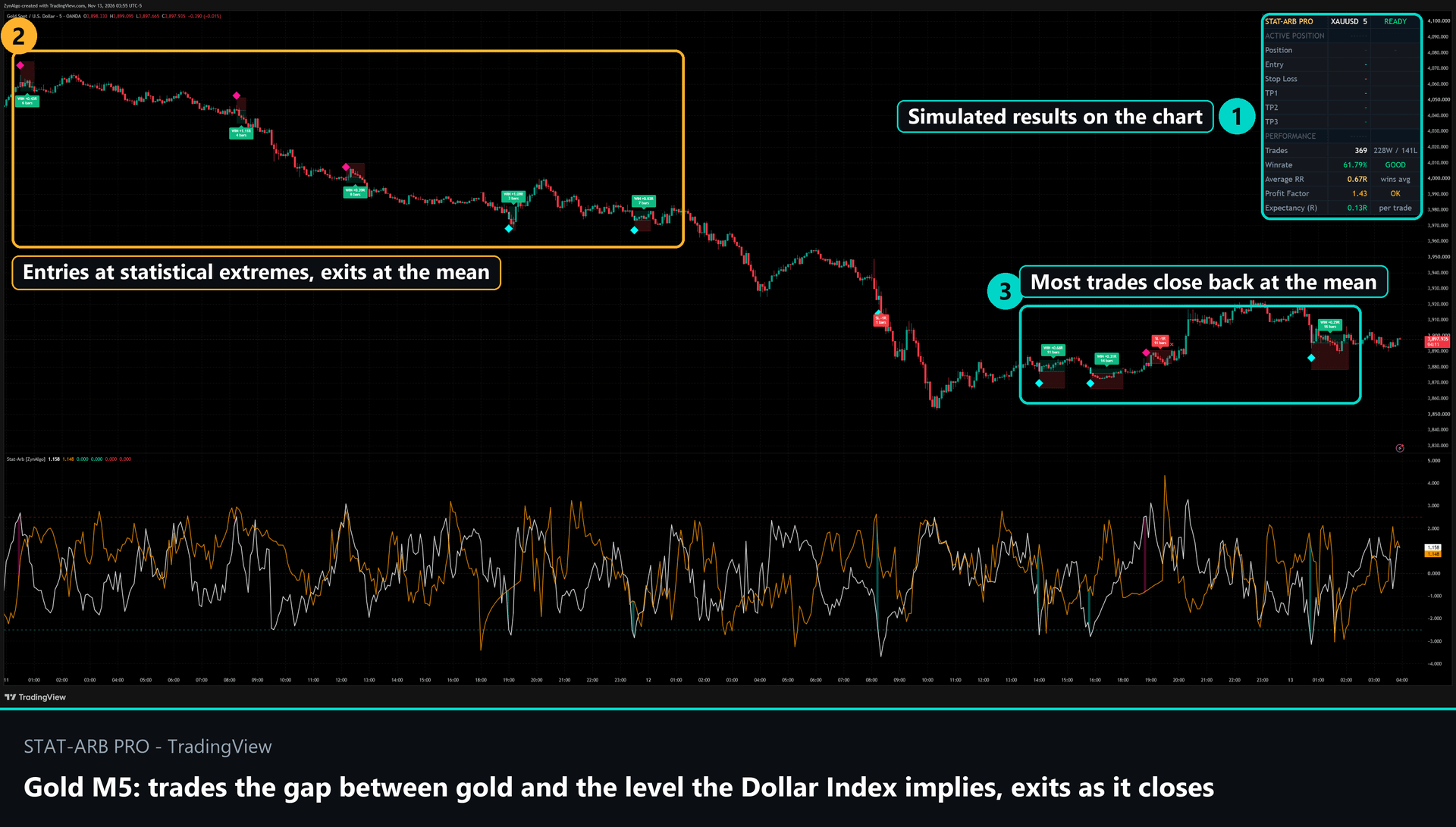
STAT-ARB Pro TDV
Trades gold's deviation from the level the Dollar Index implies and exits as the gap closes. Rolling regression spread, Auto preset for M5 and M15, closed-candle signals with a stop and a mean exit.

Step 3: apply the formula
With the money at risk and the stop in dollars, the lot size is:
Lot size = money at risk ÷ (stop in $ × contract size)
Contract size is the number of ounces in one lot. It is 100 on most brokers, but some use 10 oz or 1 oz, or list gold under a suffix such as XAUUSDm or GOLD with its own settings. Check the symbol specification once and use that number.
Worked examples (100 oz contract)
| Account | Risk | Money at risk | Stop | Lot size |
|---|---|---|---|---|
| $2,000 | 1% | $20 | $4 (40 pips) | 0.05 |
| $10,000 | 1% | $100 | $5 (50 pips) | 0.20 |
| $10,000 | 1% | $100 | $10 (100 pips) | 0.10 |
| $50,000 | 0.5% | $250 | $8 (80 pips) | 0.31 |
| $100,000 | 0.5% | $500 | $12 (120 pips) | 0.41 |
Always round down to the nearest 0.01 lot. Rounding up quietly increases your risk on every trade.
When the answer is less than 0.01 lots
On a small account with a wide stop, the formula can return something like 0.004 lots. The smallest lot most brokers allow is 0.01, so the real risk would be higher than planned. The honest options are a tighter stop, a bigger account, or skipping the trade.
Sizing gold trades on a prop firm challenge
Prop firm challenges are rarely failed by one bad idea. They are failed by a normal losing streak that runs into the daily loss limit. Gold makes that easy: two or three stops in a fast session can use up a 5% daily limit before lunch.
A safer way to size for a challenge:
- Work out today's room. Daily limit in dollars minus any loss already taken today. On a $100,000 account with a 5% limit and a $1,000 loss so far, you have $4,000 left.
- Pick the losing streak you want to survive. Three losses in a row is a sensible minimum on gold.
- Divide. $4,000 ÷ 3 = $1,333 maximum risk per trade today. If your normal risk is higher, cap it.
- Check the max drawdown too. A 10% overall limit on $100,000 is $10,000. At $1,000 per trade that is ten losses, which is the real cushion for the whole challenge.
Firms measure these limits differently. Some count open losses, some use a trailing drawdown, and many reset the daily limit at a fixed server time. When the rules are unclear, size smaller than the maths allows.
The Gold Lot Size Calculator does these four steps for you in prop firm mode: it shows the room left today, the safe risk per trade, how many losses you can take before the daily limit or max drawdown, and how many winning trades the profit target needs at your reward-to-risk.
Common gold sizing mistakes
- Dollars read as pips. A $5 stop is 50 pips on most brokers, not 5.
- Same lot on every trade. A fixed 0.50 lot risks $250 on a $5 stop and $1,000 on a $20 stop. Fix the money, not the lot.
- Wrong contract size. Using 100 oz maths on a 10 oz symbol makes every trade ten times smaller than planned, and the other way round is worse.
- Ignoring spread on tight stops. On a $2 stop, a $0.30 spread is 15% of the risk. Very tight stops on gold often cost more than they look.
- Sizing up after a loss. On a challenge this is the fastest route to the daily limit.
Frequently asked questions
How much is 1 lot of gold worth per $1 move?
On a standard 100 oz contract, $100 for every $1 the price moves. That is $10 per pip ($0.10) and $1 per point ($0.01).
What lot size should I use on a $1,000 gold account?
Risking 1% ($10) with a $5 stop gives 10 ÷ (5 × 100) = 0.02 lots. With a $10 stop it is 0.01 lots, the smallest size most brokers allow.
Is 0.01 lot on gold safe?
It depends on the stop. 0.01 lots risks $1 per $1 move, so a $20 stop risks $20. On a $500 account that is 4% on one trade, which is a lot. Safety comes from the money at risk, not from the lot size itself.
Does the formula change for a prop firm account?
No, the formula is the same. What changes is the money at risk: it is capped by the daily loss limit and the max drawdown, so a challenge usually needs a smaller risk per trade than a personal account.
Where ZynAlgo fits
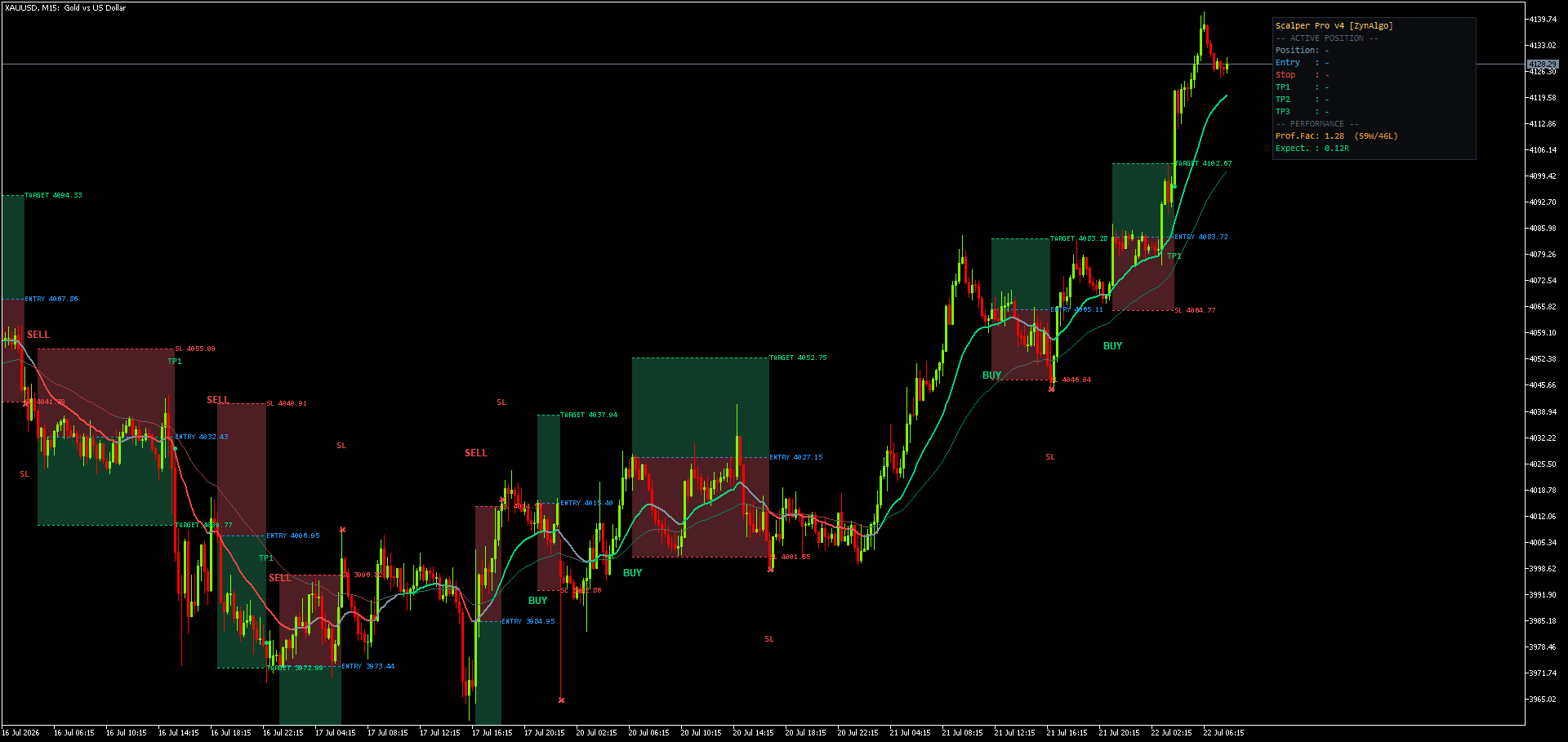
A lot size is only as good as the stop you feed into it. ZynAlgo indicators print their signals only after the candle closes, with the entry and an ATR-based stop drawn on the chart, so you always have a real stop distance to size from. If you want the sizing done for you, ZynAlgo Automation can place each signal with a fixed percentage risk per trade, recalculating the lot on every signal.
Start with the free tools: the Gold Lot Size Calculator and our free trend indicator on the same page.
This article is educational and is not financial advice. Trading gold carries a high level of risk. Figures are examples and ignore spread, commission, swap and slippage.
STAT-ARB Pro TDV
Trades gold's deviation from the level the Dollar Index implies and exits as the gap closes. Rolling regression spread, Auto preset for M5 and M15, closed-candle signals with a stop and a mean exit.